Free City of Haven
Info
Burroughs and Neighborhoods
- The Heights
- The North Corridor
Barristers’ Maze
Believer’s Lane
The Glens
Trademasters’ Square- Trade Island
- The Bridges
- The Commons
The South Docks- The Labyrinth
The Street of Silk Veils
The Forgotten City- The South Corridor
Horse Market
Magic Street
South Caravan Street
The Street of Harps
The Cleff
The Grey Halls
Thieves’ Market- The Outlands
Erinhir
The Dwarrow
The Dell
The Cauldron
Scholar’s Triangle
Type: Large city
Other Name(s): Haven
Located In:Population: 80,000
Demonym: Havenite
Founded:
Runied:Ruler:
Rank:
Ruling Organization:
Other Rulers:Founders:
World Anvil Metadata
Id: e22fc33b-10f4-4078-ac2c-fea0be7d20f8
Entity Type: Article / settlement
Category: Haven
Tags: fcoh,capital
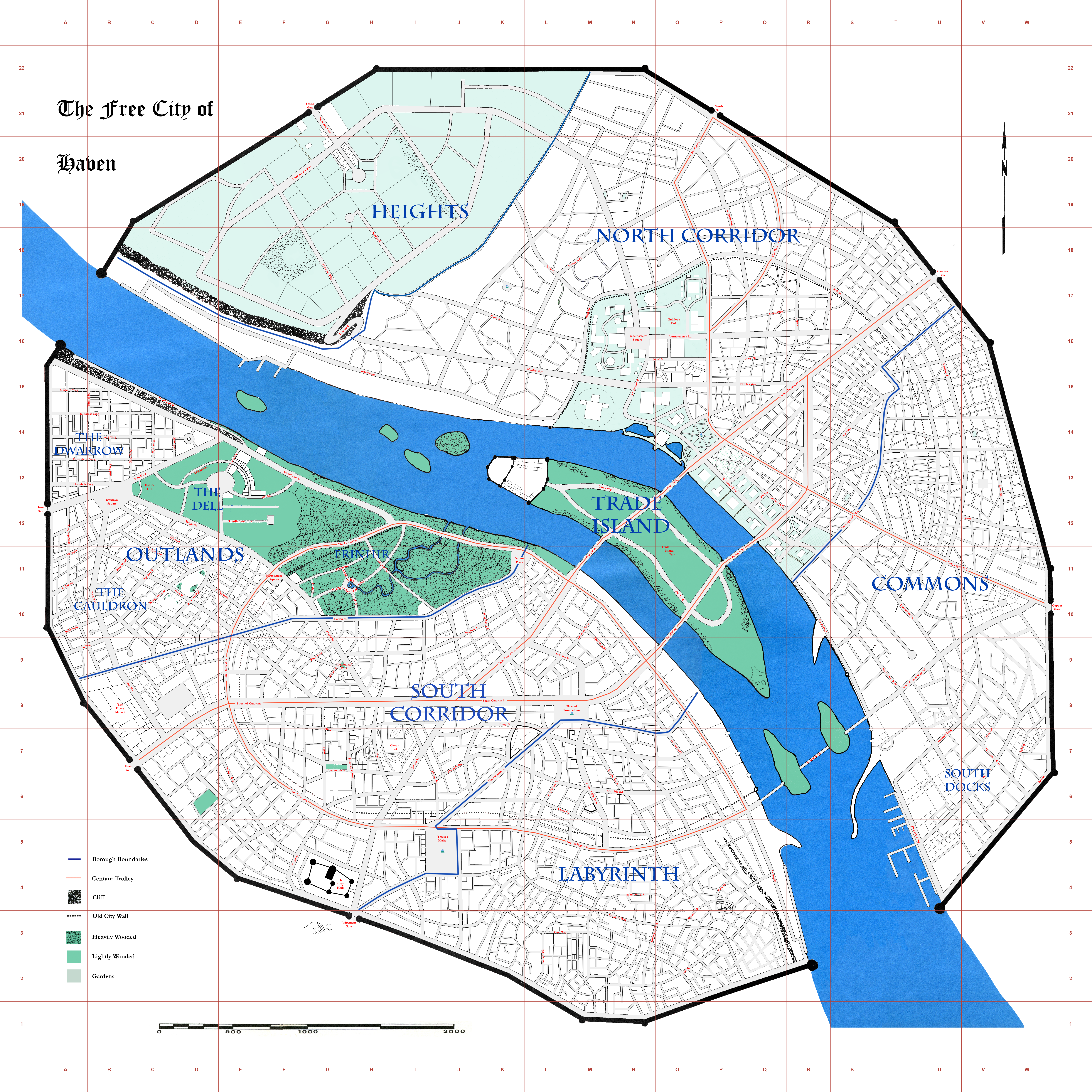
At the north end of Trade Island stands a strong citadel, guarding the Long Road, the main east-west passage of trade since the beginnings of the Namori Empire some 2,000 years past. The Citadel Guard has held to its duties for nearly that long.
Haven itself began as a small collection of huts on the south side of the river two and a half millennia ago and has risen and fallen many times (the ruins at the southern tip of the island date from about 1,500 years past), sometimes expanding, sometimes contracting.
Because of the availability of good communications via the Long Road or the Dorian, Haven is a natural political center and has grown to be a thriving nexus of trade government and manufacturing.
Presently, Haven is of reasonably large size (there are 80,000 stories in the naked city) and sits squarely across the Long Road on both banks of the Dorian. Within the city’s walls are a multitude of shops, residences, taverns, warehouses, and of course, people.
About 175 years ago, economic necessity and pressure from the growing trades forced what little was left of the Namori Empire to grant a charter to the city, making it an independent political entity ruled by a Duke and providing more power to the people by way of an elected Council of Boroughs. Among other rights and privileges secured by this document was the freedom of the slaves, along with a recognition that slavery, per se, would never be permitted within the city again; indenturing, however, is not uncommon and is sometimes the only recourse a debtor has to avoid prison.
Since that time the merchant class has steadily grown and some noble families were forced into selling off their lands to satisfy their creditors (the cannier members of the various trade Guilds). Today there are several wealthy merchant families and well-off individuals … and far fewer noble families. This has led to a certain amount of rivalry between the nobility and the nouveau riche for the Duke’s ear.
There are myriads of opportunities for a single person or for almost any group of adventurers - all they need to do is enter “THE FREE CITY OF HAVEN” and look for them
Demographics
Haven has grown to be a thriving nexus of trade government and manufacturing, with a population of almost 80,000. The traveler will find that most races of Antheros can be found living here. While most of the population are humans, there are Elves, Halflings, Dwarves, Centaurs, Half-orcs, Tieflings, and even the occasional Avanthar, Goliath, Pixie, Goblin, or Troll living in relative harmony.
It is a polyglot city, a world of many colors, many languages, and many lifestyles. There are scholars and businessmen, priests and courtesans, fighters and thieves and mages - the city throbs day and night with the pulse and breath of adventure.
Government
For the formal government, refer to Government of Haven. There are however several Major Families and Power Brokers who work both within and outside the government.
Defenses
Refer to:
Industry & Trade
Infrastructure
Haven is unique in that it has a Public Transit system run by the local centaur population.
Districts
The Heights
Since the time when Haven expanded to its present boundaries, the city’s aristocracy have made their homes atop this rambling, fertile greensward overlooking the north banks of the Dorian. Many of the stately residences were adorned with elaborately landscaped gardens, pools, and private stables, or set off from public view by high stone walls or hedges. In these surroundings, the nobility entertained themselves lavishly; feasts, and hunts in the nearby countryside, and bacchanalian revels that were the stuff of legend in the commoner parts of town.
The North Corridor
Probably the richest sector of the city, spreading mainly to the west of Caravan Street, it contains a large shopping and trade section (stretched along the main avenue, Caravan Street), the financial sector, the major guild halls, the government buildings and Courts, and the homes of many wealthy artisans and merchants.
Trade Island
The island splits the River Dorian into two deep and Rocky gorges of rushing rapids. Is is nearly a mile in length with two sets of bridges, Stonebridge and Woodbridge, that cross the river via the island. This is the only place the Dorian may be bridged for commercial traffic. Trade Island has served as a neutral meeting place for merchants and traders for countless centuries, even before the city existed. Those who buy and sell on Trade Island, rate no warehouses, large caravans, or trade ships; they are considered the least of the merchants and traders of Haven; they are the Free Traders, wandering folk, and various craftsmen.
The greater part of the island is an open-air bazaar, where all manner of goods may be found (if one looks hard enough). The bazaar is a sprawling tapestry of color and sound, where traders and craftsmen display their wares from wagons, tents, pavilions, hastily constructed booths, or from scattered camps.
The Commons
Without any competition, the The Commons is the largest borough in the city in population. It occupies almost everything to the east of Journeymen’s Road and Caravan Street on the north side of the river, includes the section east of The Trax and north of Wall Street, and contains most of the factories located inside the city’s walls. One quarter of the city’s population lives here, and they are the primary labor force for these factories (factory as applied in the context of the city of Haven does not mean one of the highly automated, noisy, smoky leviathans we know in 1981 - it doth refer to a building in which different items are made, but there are few assembly lines, and any technological equivalents tend to be arcane, not mechanical; there are simply a lot of people engaged in making the various products of the business), and tend to be on the lowest scales of income available (just above the beggars).
The Labyrinth
Haven’s most notorious borough, the The Labyrinth is a maze of dirty narrow streets, alleyways, and cul-de-sacs lined with shabby, decaying tenements and abandoned warehouses. Buildings are primarily clay block and wood, and are generally in a state of disrepair and neglect. The streets are little better, muddy and mostly unpaved, and sport deep holes to catch wagon wheels and unwary pedestrians. Trash and refuse litter the streets and accumulate in the alleys, to be picked over by rats, mangy cats, and tieflings.
The South Corridor
This is the most active of the boroughs; it seems to be alive around the clock, as it is the location of the largest of the caravanserais and hostels in the city. Shops and taverns abound in the borough, and the residential areas are crowded with inhabitants. Each of the major sectors of the borough (South Caravan Street, Magic Street, the bards’ quarter along The Street of Harps, the great plaza called Thieves’ Market, and the Horse Market) has its own particular flavor and tempo. Even the various residential areas seem quite differentiated
The Outlands
The most diverse of Haven’s six boroughs, it is the home of the more affluent members of the non-human races. Each of the major races has its own quarter, where the living conditions are quite similar to those in their homelands. The quarters are:
- The Dell , a meadow and hill area favored by the halflings
- The Dwarrow , primarily underground construction sunk into the bedrock of a largish hill, living and working area for the most businesslike of the younger races, the dwarves
- Erinhir , the River-Forest, where, amid stately trees, some nearly as old as the city itself, dwell the elves (some nearly as old as the city itself).
- The fourth quarter is called The Cauldron alluding to the melting pot quality of the mixture of races, and is the home of the less wealthy. The centaurs have no special quarter of their own, since they normally prefer to live outside the city’s walls, and they share this southern portion of the The Outlands will all the other races.
Guilds & Factions
Refer to the following articles:
Less publicly known groups include:
- Thieves Guild
- The Black Hand
- Young Stallions
- Brotherhood of the Broken Blade
- Disaffected Artisans
- Companions of Silverthorne