Thieves’ Guild
The Free City of Haven Thieves Guild is a loosely defined organization whose territory encompasses most areas of Free City of Haven, and most of the thieves within them. In a few parts of the city, notably The Commons and The South Docks, the Thieves Guild faces competition from the Black Hand, its arch rival that is so intense as to almost prohibit Guild operations. In other areas, such as the rich North and South Corridors, the preponderance of Guild thieves makes itself felt, much to the dismay of competing Black Hand second story men. In all, some four hundred thieves are part of the Guild, ranging in skill from back street alley bashers to professional safe crackers, from the small time pickpockets who work the great squares of the two Corridors to the highly skilled burglars who work the mansions in The Heights.
The authority of the Thieves Guild in The Labyrinth remains unchallenged by the Council of Masters because the Guild confines its most nefarious activities to that locale, and because the cost of rooting it out of The Labyrinth would be expensive both in money and in the lives of the people who actually did the uprooting. However, maintenance of this truce makes it very important for the Guild to keep the levels of crime committed elsewhere in the city at reasonable levels, so as not to antagonize too many people in high positions. By walking the thin line between acceptable and unacceptable levels of crime, the Thieves Guild ensures that its activities will continue relatively unchecked by the civil authorities. The maintenance of this delicate balance is one of the primary responsibilities of the Guild Master.
No one knows for certain how the thieves of Free City of Haven first came to band together. There are, of course, legends that attribute this feat to the prodigious efforts of Bradamas Kurgan, the infamous and charismatic scoundrel who dominates local folklore, but there is no tangible evidence to support these assertions. The earliest written records of the Guild suggest an organization bordering upon anarchy, providing little else than a sense of fellowship and occasional assistance. Later records in the Guild annals chronicle the development of the “darke bruthirhude” into the structured and tradition bound hierarchy that it is today.
The title of “Grandmaster” is first identified with the thief Rafkulin, who earned the accolade in a challenge duel of thiefly prowess with another high level thief. The title remained largely symbolic for many years, until it was won by a brash young upstart by the name of Del ur-Venite. Venite, a man of vast ambition and matching capabilities, successfully guided the Guild in the execution of a number of daring robberies that in a single month filled the group’s coffers with as much treasure as was normally taken in a year. Venite began the custom that each thief tithe a portion of his earnings to the Guild to maintain its treasury, and devised the Guild’s membership badge, the tattoo of a lidless eye, then placed on the palm of the left hand (now moved to the wrist).
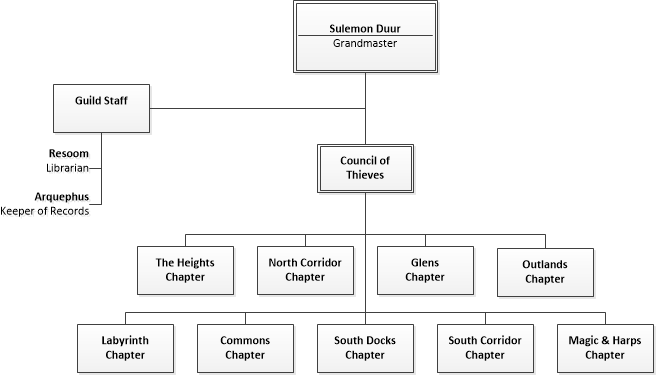
Later, as the Guild grew, Venite began to invite the Guild’s best thieves to be members of the “Thieves’ Council”, and assumed the title Grandmaster for himself. During the ensuing centuries, the Thieves Guild Grandmaster, through his Masters sitting on the Council of Thieves, has controlled the activities of nearly every cutpurse, cat burglar, confidence-man, and beggar in Free City of Haven.
Rogues’ Roost and the Great Fire
In order to properly direct such authority, the Guild Master needs assistance from scribes and librarians, who maintain the records and briefs to keep him properly informed. Thus, as the Guild grew larger, a central establishment was necessary to house the Guild Master and his staff. This was the origin of Rogues’ Roost, the great warehouse turned Guild House where the Guild Master resided. As the organization became more elaborate, other functions were moved there as well, including trainers for apprentice thieves, a guild healer, dormitories for homeless thieves, and a weapons master to train the fighters of the organization.
The Guild has built up a repository of information (a sizable portion of which was saved from the burning Roost by the valiant efforts of the Guild Librarian), containing details of floor plans, courier routes, guard schedules, and so forth, that often provide valuable aid to scheming thieves. The city’s beggars are used as a network of informants to keep such information fresh, and a similar network of businessmen has been located who can be counted upon to pay a fair price for the purloined fruits of a thief’s labor. The Guild Masters also exert a more subtle influence on events, by cultivating (either through the judicious use of cold cash, or through information about a target’s past indiscretions) the cooperation (however reluctant) of a number of highly placed political and judicial officials. As the need for funds has grown, so too has the Guild’s internal discipline, and its enforcement of “tithing” by individual thieves on a regular basis. The Guild has gone to great lengths to ensure that thieves not obeying this dictum are promptly found and punished (the severity of the punishment depending upon the amount withheld); likewise, because they do not tithe to the Guild, and compete with those who do, independent thieves are not tolerated, and the Guild, once a voluntary association, has now become a mandatory one.
As a consequence, when a Black Hand suicide squad burned the Roost to the ground some six months ago, a great blow was struck to the Guild though some material was saved from destruction. The librarian, Resoom, rescued many of the most important documents from the Guild archives, and further information was stored in the treasure vaults, safe from the fire. In addition, although the Guild Master at the time, Azimuth, is believed to have been killed in the fire (his body was never found), many other Guild personnel managed to escape, including the Librarian, the Master of Novices, the Weapons Master, the Quartermaster, and a number of others. Much of the sensitive magic owned by the Guild, particularly the ancient and mostly irreplaceable traps located throughout the old Roost, was destroyed, as were many of the more recent blackmail files (which had not yet been copied and stored in the vaults). Even more tragically, from a gourmet’s point of view, the wine cellar was not as secure as the treasure vault, and many of the fine wines were ruined by the heat.
Membership Benefits
Membership in a Guild chapter provides immediate benefits which offset the 15-25% cut the Guild extracts from each and every haul. Besides access to two or three fences of known quality and fairness, and the hiding places maintained for those occasions when matters get hot with the authorities, the Master of each chapter makes sure that all of his thieves are assigned a reasonable territory, with lucrative pickings and minimal competition from other thieves. Assignment to the better territories is, of course, a matter of seniority and preference, but even the worst can support a diligent thief.
Furthermore, the Guild looks after its own. Thieves caught and subject to official discipline are given the best lawyers that the Guild can afford (how good that is is also a matter of preference and status within the Guild, but even so, the Guild will almost always provide a competent lawyer), and occasionally, the Guild has even sprung its members from The Grey Halls.
Guild journeymen, who have achieved their position usually because of skill, have access to the Guild Hall records (mostly through the Intervention of the local Master, who will provide copies of relevant floorplans and what not), and lead the larger expeditions. The better apprentices will assist them in such operations. Apprentice thieves rarely get direct access to the choice bits of Guild documents or maps, unless they have pleased the Master of their chapter by their wit or skills.
Joining the Thieves Guild
Membership in the Thieves Guild with all its benefits and responsibilities is considered a sign of status in some parts of town such as The Labyrinth, and is not as easy to come by as one would think. A thief who wishes to join the Guild (and if he plans to practice his profession in any part of Free City of Haven where the Black Hand does not hold sway, he’d better be a member) must prove his skills to the local Master, usually by performing a specific robbery or other task. The potential member must also pay 500 GP to cover “Initiation fees”, and, if accepted by the Master and his Lieutenants of the local borough, must undergo the ritual of initiation. The initiation includes both an ordeal and a secret ceremony, and is usually held at the chapter House.
Initiations from apprentice level to journeyman or from journeyman to Master are held at the Guild House itself. Unless the prospective member is really exceptional, he will automatically become an apprentice, responsible to one of the Lieutenants of the chapter into which he is initiated, and may receive training at the hands of the Master of Novices (at the usual rates, of course; normally high enough to keep an apprentice in frequent practice of his new trade).
Not all members of the Thieves Guild volunteered; some were originally independents drafted into the organization after being caught by the Guild practicing crime without the benefit of Guild membership. Upon catching such an independent thief, the lieutenant will explain the reasons why the thief should immediately join the Guild, some of which are standing behind him with stout cudgels and nasty grins. The new member is “initiated” practically on the spot, with the total of his take from the robbery going to pay his “fee”. If the new member does not live up to the obligation of membership (like neglecting to hand over his tithe), he is severely disciplined, and may even be killed if he persists in his actions.
Notable Members
- Guildmaster Sulemon Duur
- Azimuth, deposed Grandmaster (now in hiding)
- Neshima Kar-Aurim
- Daquis Reeve
- Resoom, Guild Librarian
- Madame Zanwig
- Gidri and Gossij
- Lando Buckminister
- Evan Monier
- Arquephus, Keeper of Records
Alley Bashers, Leg-breakers and Other Muscle
The men (and occasionally women) who fall into this segment of the underworld make their livings through a mixture of rather violent enterprises like back-alley muggings, acting as enforcers for protection rackets or gang bosses, contract beatings, etc. In many ways, thieves in this category are virtually interchangeable. Unlike many of their counterparts, these rogues are generally about as subtle as a slap in the face; often they are a bit deficient in the intellect department as well. Sent out to accomplish an objective, they are often likely to leave a trail of overt clues in their wake or bungle the job through their inability to think quickly or react to changing circumstances. Nonetheless, such men can have definite uses in a party, if they can be kept under control. They are often used to add muscle to a highwayman expedition, and there is no better companion should a brawl break out in one of the seedy dives of the The Labyrinth. When times are hard, some will hire on as fighters with expeditions organizing in Haven; such pairings are often not fortuitous, for while a basher possesses the physical and weapon skills necessary to be a good warrior, many are bullies at heart with little love for a fair fight.
The following are sample characters of this class of thief for GMs to use as hirelings, potential encounters, or to accompany other NPCs as their strong arms.
- Lefty Grazziano: Soft-hearted as an enforcer, he often lets people off the hook. If Lefty is attacked, or discovers he’s been taken advantage of or made to look the fool, he’s a raging bull.
- Cruncher McGee: Cruncher is slow-witted even by alleybasher standards, and has a tendency to forget even simple instructions if left alone for more than five minutes. His chief value is as a visible threat, and he is very good at crushing bricks to rubble with his bare hands as a demonstration.
- Foxcraft Q. Pennywhistle: Sometimes, alleybashers are made, not born. Foxy’s mom wanted him to be something dignified, like an artisan or barrister - she had no idea that her son would grow up to look like the entire Green Bay Packer front four. The taunts of his childhood, and the fights that followed hardened him into a sullen man. Foxcraft never trusts anybody, and seemingly small disagreements will set him off with a vengeance. If you like working with a time bomb, here’s your boy …
- Merrick: Uses slow-wittedness as a ruse, since anyone so obviously brawny is rarely expected to be bright. Merrick is actually a Black Hand informant, very cagey and observant, who seldom makes a slip out of his dull-thinking character.
- Dragontooth: A psychopathic killer 10% of the time, otherwise a normal thug. Uncontrollable once in a state except by magic; Dragontooth once served a mage who knew his problem and kept it under control except when it suited his purpose. Dragontooth is particularly susceptible to SLEEP and CHARM spells, and saves against them at a penalty of 6.
- Raven: Streetwise and a savvy brawler, Raven knows every dirty fighting frick in the book, and a few that have never been published. His agility and speed more than compensate for his lack of size, and he is never without a hidden weapon.
- Rioldi Thorn: A serious alcoholic, he will almost certainly show up for the job “hollering drunk” if paid any portion up front (which he will try to insist on). Very competent when sober. Neither the Guild nor the Hand will use him now, having been too often burned in the past. If the players are Guild or Hand members, there is a 60% chance they will know his reputation.
A Gourmet’s Selection of Common Thieves
The following characters fall into the general category of thief, a character who makes his or her living by relieving other people of their property in some manner, whether it be by burglary, armed robbery, pickpocketing, cut pursing, or a confidence scam. Thieves generally depend more on their wits and dexterity to keep their skin intact in this somewhat risky career than skill with weapons or brute strength. They also tend to specialize in one or two particular areas of crime, honing their skills for that modus operandi to a fine pitch, rather than trying to be successful in all forms of criminal endeavor (for more general and specific information on thieves, thieving skills, etc., see the Thieves’ Guild series by Gamelords). The following characters are a sampling of some of the many members of the thieving profession in Haven, and can be used by GMs much like the alleybashers and thugs mentioned above.
- Sarasin Mour: An Easterner, dark of skin and hair, speaks with a soft lilting accent and dresses in loose trousers, shirts, and a turban. More of a con-man than a thief, he is clever, a glib talker, and thinks fast on his feet. His thieving skills are good, but he considers burglary to be too much like work, and so makes his living running various scams. Always on the move, with no fixed abode, he is extremely difficult to find once the scam is revealed.
- Ernie and Mugs: A Laurel and Hardy team, these brothers work together on armed robberies and burglaries. Ernie is small and wiry, and provides the brains of the operation, while slow-witted Mugs provides the muscle. Unfortunately, with only one brain between them, their success rate is not high; Ernie’s plans start out logically but often go awry due to later elaborate embellishments, while Mugs can remember only the simplest of instructions and is apt to falter in or bungle the job assigned to him.
- Dickens: A hulk of a man, with an unshaven face and dark, brooding eyes, Dickens is sullen and dangerous. Muggings and armed robbery are his favored styles, with his trusty blackjack or a wicked long- bladed dagger. He has also done some burglary, using a captured street rat to slip inside to unlock the doors. Dickens is a brutal man, a cold-hearted bully, mistreating even his mistress, who is surprisingly devoted to him.
- Custer: A cutpurse and pickpocket, Custer’s favorite trick is the use of a gaudy red hat to attract attention away from his face. To affect his disguise, he discards the hat, and fades into the crowds. His plain features and drab clothing also serve to make him less memorable. The ruse is so successful that Custer has had the chance to hone his pickpocketing skills until he rarely has to rely on the hat to save his skin.
- Yacobur: A plain-looking dwarf with hungry eyes, Yacobur is a reasonably skilled thief; he is also a compulsive kleptomaniac. His normal dwarvish lust for material wealth is far beyond his control and often leads him into some very close scrapes as he strives to possess whatever bauble has caught his eye.
- Chalka: A former street rat, Chalka is small and lean, her dark hair cut short like a boy’s. Time spent as a child hanging around the acrobats and tumblers of Circus Park was put to good use; Chalka is an expert climber, but prefers the more lucrative career as a second story burglar to that of a carnival acrobat. She is also a practiced lock pick. Part of her success is due to her careful planning of any heist; Chalka never takes needless risks, and will abort a job if something unexpected occurs that she had not planned for.
Common Information
Basics
Type: Guild, Thieves
Leader: Sulemon Duur
Structure
The Thieves Guild is presently led by Sulemon Duur Duur, the ex-Master of The Labyrinth chapter, who succeeded to the Guild Master’s title upon the disappearance and presumed demise of the Guild’s former leader, Azimuth, in the Rogues’ Roost Blaze.
In addition to the Guild Master and his staff, the Thieves Guild consists of nine chapters, each with a separate regional jurisdiction, and each led by a Master thief who holds a seat on the Council of Thieves. The duties of the various Masters include planning operations within their area (making sure that the shops and businesses that have paid for Thieves Guild protection are not robbed, and that those which have not are not robbed too often), assigning territories to the sundry pickpockets and alley bashers in their ranks, maintaining Thieves Guild safe houses, and, when necessary, directing operations against the Black Hand.
The regional jurisdictions of the chapters do not correspond exactly to the boundaries of the various boroughs, and vary tremendously in size and composition. The master of the chapter responsible for The Heights, for example, has only three journeymen and perhaps fifteen thieves under him at any given time, while the master of the chapter in The Labyrinth has nine journeymen and as many as sixty apprentice thieves. In general, the chapters are concentrated most heavily in the Corridors, and have thirty to forty apprentices, and four or five journeymen.
Each chapter maintains contact with a number of fences, and has at least one central meeting place available to its master. Most chapters maintain safe houses and message drops, and have several couriers delegated to keep contact with neighboring chapters. The Master is the ultimate authority within a chapter’s area, and is responsible for keeping order, settling disputes, assigning territory to new recruits, and moving older thieves out of an area when their faces become “known”.
Underneath the chapter Masters are the Guild journeymen, the women and men who are the day-to-day managers of Guild activities ensuring that the Master’s plans actually take place. Beneath the journeymen are the great mass of Thieves Guild members, the apprentice thieves that the organization was originally intended to help, but now simply controls.
```col-md
Previous: ac12335f-896e-4057-a64a-2eca2adbf78e
```

```col-md
textAlign=right
===
Next: d1a96263-4191-482e-ace6-360d25106f60
```