The Black Hand
During the long history of Haven’s Thieves Guild, there have been numerous occasions when dissatisfied thieves, for one reason or another, have split from their parent organization to form rival operations of their own. Most of these rival groups were quickly subdued by the Guild, and the renegades (minus a few chosen to serve as examples to others with like minds) were returned to the fold. The latest and best organized of these renegade bands has been that group known in Haven as The Black Hand.
The original break with the Thieves Guild occurred because a number of highly competent thieves had been neglected for promotion to Master, and hence into the increasingly aged and isolated Council of Thieves. With opportunity for advancement within the Guild blocked, and no indication that this situation would change, these men set out to establish their own guild with themselves at the top.
The Hand’s organizers had pondered well the fate of their predecessors in rebellion, and vowed not to repeat the mistake of acting prematurely. When the most vocal of the malcontents left the Guild, they left the city as well, supposedly to seek their fortunes elsewhere. Meanwhile, a number of unrevealed sympathizers who remained in Haven recruited additional supporters, and met with those city figures believed to be disenchanted with their “cooperation” with the Guild. When the leaders returned, they had considerable financial resources, and friends capable of exerting influence in high places - and when the moment of open revolt came, almost one fifth of the Guild’s membership defected to the Black Hand.
The original Black Hand organization consisted of several guilds, each led by one of the original malcontents, occasionally added to as the Black Hand diversified its operations. Meeting in council as co-equal guild masters, the founders perceived the need for a larger-than-life unifying symbol; the result was the mysterious, soon legendary Father Marco. Today, only one of these original leaders remains, kept young by artificial means, a twisted genius, now undisputed in his leadership, and obeyed by his subordinates as much from fear as from respect. Some years ago he began calling himself Marco and now his original identity is mostly forgotten - man has merged with myth.
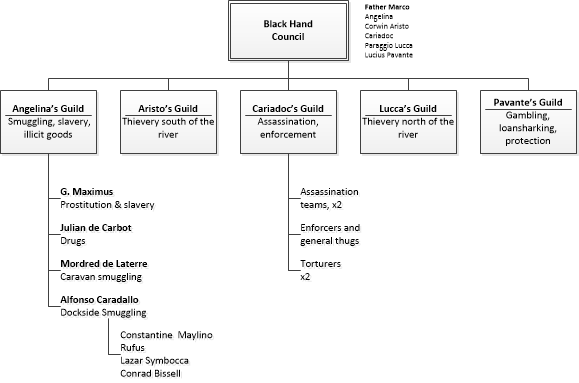
Given the Thieves Guild’s superior resources and entrenched position, the Hand has been forced to develop a different, more covert modus operandi than its rival. Rather than utilize a direct, centrally organized command chain, the Black Hand leadership runs a far more diffuse cellular system of semi¬autonomous guilds. Five such subordinate guilds, designated by the names of their masters, currently make up the Black Hand: one oversees mayhem of all sorts, and provides protection for the rest of the organization, one controls extortion, including loansharking and gambling, another runs Black Hand interests in smuggling and assorted vices, while two more handle traditional burglary, thieving, and second story operations. The “dues” paid by the member guilds are used by Marco and his leaders to finance the more expensive components of a successful criminal network - the legitimate investments, arrangements with fences and informants, bribes for officials, and magical paraphernalia. The Hand’s resources in these areas, however, are still far inferior to those of the Guild.
Joining the Hand
Joining the Hand varies in difficulty from member guild to member guild. The two “traditional” thieving guilds are the most elitist, and will only induct other thieves into their guild if they appear competent and experienced; the current conflict with the Thieves Guild is taking a high toll of Hand thieves, however, so that exceptional non-Hand thieves caught practicing their trade in Hand controlled areas may be given the opportunity to join as full members, rather than being summarily killed. Thieves who make an effort to contact the Hand (the easiest method is to ask around in the seedier taverns, and they will eventually find you) will be given a low cell level contact and asked to bring to that person a certain amount of money, usually on the order of 5-10,000 GP, to be stolen within the next few nights. Successful completion of such a task will bring about a probationary membership within the guild and induction into a low level cell; probationary guild members “donate” almost all of their take to the Hand treasury. After about three months, the cell will hold a meeting to decide if the probationary member is good enough to enter the guild; should they decide yes, the thief in question becomes a full member - otherwise, he is quietly eliminated.
Recruitment into the other guilds is more complicated. More specialized operatives, such as assassins or loan sharks, are usually recruited from within the Hand, as occasion demands. Less specialized men, such as thugs, alleybashers, protection racketeers, and extortionists, are recruited from the normal lowlifes around the city. Very specialized types like sea captains and caravan masters, whom the Hand cannot itself train, are inducted into the Hand slowly and carefully, and only trusted after several years of association (usually after the Hand has accumulated a sufficient amount of blackmail material against the person in question). The only common denominator is the general principle that one does not approach the Hand, the Hand approaches you.
Common Information
Basics
Type: Guild, Thieves
Leader: marco
Structure
Each Black Hand member guild is divided into a number of small cells, the leaders of lower level cells themselves form cells receiving orders from yet another designated commander. Since the member guilds are not large, rarely containing more than thirty or forty members at any given time, there are usually only two or three levels in the cell hierarchy before the guild master himself is reached.
The two traditional thieving guilds are not large, containing but two or three cells whose leaders report directly to their master; the others are larger, with correspondingly complex organizations. The size of a cell varies according to its function. A cell of ‘heavies’ or muggers, might contain as many as ten men, while cells of traditional thieves might contain as few as two or three. In general, members of one cell rarely know members of another, except from occasions when two or more cells have banded together for a large operation. Very large operations may demand the resources of two or more guilds, but this is extremely rare.
This structure, while less efficient in theory than the highly centralized Thieves Guild, has in practice proved immensely successful at preventing infiltration of the Hand by the Thieves Guild or Haven City Watch. Such enemies have an easy time gaining access to the lower levels of the organization, but seldom seem to progress far. By shunting identified infiltrators into lower level cells, the Hand can continue to use their thieving skills without threat to the organization itself. Furthermore, the nature of the Hand has made crackdown or elimination difficult, since the cells usually operate independently from one another, and all but the highest cells are replaceable.
```col-md
Previous: 08dce3b2-80f7-468b-be7b-dd5fdbfac799
```

```col-md
textAlign=right
===
Next: 06d842f7-8aee-4ab6-ab5e-457cc1d9484d
```